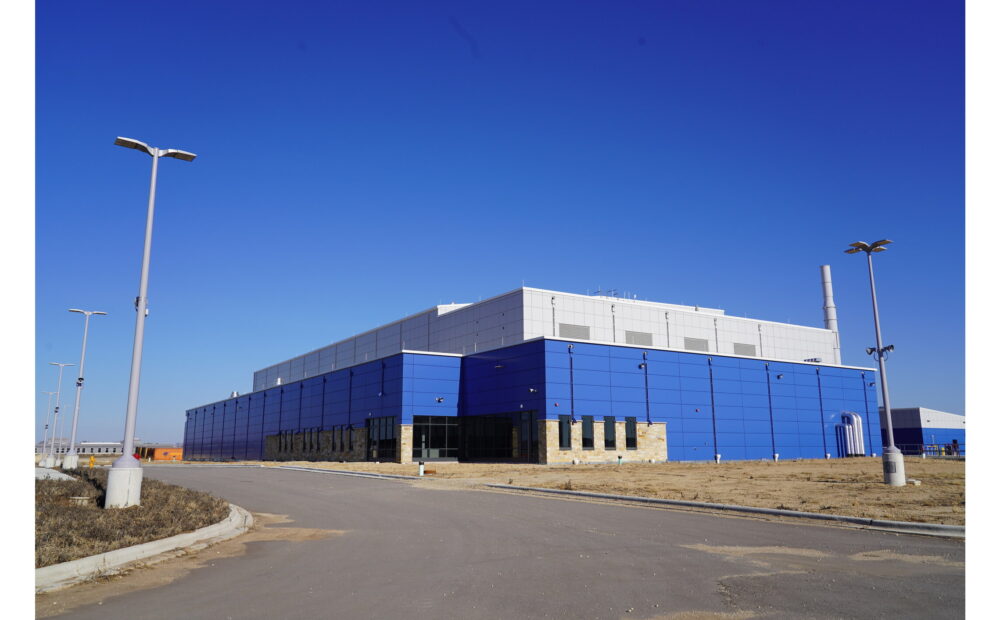
Fusion technology company Shine has received a conditional commitment for a $263 million loan from the U.S. Department of Energy to advance construction of its Chrysalis medical isotope production facility in Janesville, Wisconsin. The project represents a major investment in nuclear infrastructure, domestic medical supply chains, and advanced energy technology. Once operational, the facility will produce molybdenum-99, a critical isotope used in thousands of diagnostic procedures daily across the United States.
DOE Approves $263M Conditional Loan for Shine Chrysalis Facility
The U.S. Department of Energy’s Office of Energy Dominance Financing (DOE-EDF) issued a conditional commitment for a loan of up to $263 million to support Shine’s Chrysalis production facility.
The funding aims to help complete construction of one of the most significant medical isotope projects in the United States. The facility will manufacture molybdenum-99 (Mo-99), which serves as the precursor for technetium-99m (Tc-99m).
Medical professionals use Tc-99m extensively as a radioactive diagnostic tracer. The isotope supports imaging procedures that help physicians identify and monitor conditions affecting the heart, bones, and other organs.
According to industry data, Mo-99 supports more than 40,000 medical procedures every day in the United States. Establishing domestic production capacity could reduce dependence on foreign isotope suppliers and strengthen healthcare supply resilience.
Gregory A. Beard, director of DOE-EDF, highlighted the project’s importance for nuclear infrastructure development.
“The Shine Chrysalis project is vital to improving the nuclear supply chain and contributing to a strong next-generation nuclear workforce while onshoring this critical production and improving national security.”
Chrysalis Facility Construction Progress and Project Scope
The Chrysalis facility represents a large-scale nuclear construction project designed to combine isotope production capabilities with advanced fusion-based technology.
Shine received a construction permit from the Nuclear Regulatory Commission (NRC) in February 2016. The company began construction in May 2019 after breaking ground on the 43,000-square-foot facility in Janesville.
The project uses deuterium-tritium fusion neutron generators to support medical isotope production. Once fully operational, Chrysalis will have the capacity to produce up to 8,200 six-day curies of Mo-99 per week.
The facility includes two major operational areas:
- Irradiation units that generate neutrons for isotope production
- Processing systems that separate and prepare medical isotopes for commercial use
The integrated design allows Shine to manage both isotope generation and processing activities within a single licensed facility.
Four-Phase Construction Strategy for Chrysalis Operations
Shine is following a phased construction and commissioning strategy to bring the Chrysalis facility online.
The approach allows the company to begin production activities while completing additional operational phases.
Phase One: Initial Irradiation Operations
The first phase focuses on bringing the initial irradiation units online. These units will support early Mo-99 production activities.
Shine expects this phase to become substantially complete in 2027, allowing the company to begin commercial production before completing the entire facility.
Phase Two and Three: Expansion of Production Capacity
The second and third phases involve sequentially activating additional irradiation units.
The facility includes eight neutron generators, which will gradually enter service as construction and testing activities progress.
This staged approach reduces commissioning risks and allows engineers to validate equipment performance before expanding operations.
Phase Four: Additional Isotope Production
The final phase will introduce xenon and iodine production capabilities.
The expanded capability will allow Chrysalis to support a broader range of isotope applications while increasing the facility’s long-term commercial value.
Construction Delays Linked to First-of-a-Kind Technology
The Chrysalis project has experienced schedule extensions due to the complexity of developing a first-of-a-kind isotope production facility.
Construction was originally expected to finish in 2022. However, Shine has extended the completion timeline twice.
In December 2025, the NRC approved Shine’s request to amend its construction permit. The amendment extended the completion deadline from December 31, 2025, to December 31, 2029.
According to the DOE, the facility is currently approximately 75% complete.
Shine stated that additional construction time will support:
- Completion of remaining building systems
- Preoperational testing
- Equipment validation
- Regulatory licensing activities
- Commissioning of all four operational phases
Large nuclear construction projects often require extended timelines because they must meet strict regulatory requirements. Engineers must verify safety systems, radiation controls, structural integrity, and operational reliability before commercial operation begins.
Nuclear Technology and Domestic Supply Chain Impact
The Chrysalis facility supports broader U.S. efforts to establish domestic production of medical isotopes.
For decades, the United States has relied heavily on international suppliers for Mo-99. Supply interruptions have created concerns about healthcare reliability because medical facilities depend on consistent isotope availability.
Shine’s project aims to strengthen domestic production through advanced nuclear technology while reducing reliance on foreign sources.
The DOE and National Nuclear Security Administration (NNSA) have supported Shine’s technology development through research programs focused on establishing reliable Mo-99 production without using high-enriched uranium.
NNSA Support for Advanced Medical Isotope Production
Shine developed its technology with support from the NNSA under programs created through the American Medical Isotopes Production Act of 2012.
The legislation established a technology-neutral initiative to encourage domestic Mo-99 production while supporting nuclear nonproliferation goals.
National laboratories also contributed research and technical expertise during the development process.
Shine’s irradiation units produce Mo-99 by creating a subcritical fission reaction using an aqueous low-enriched uranium target containing 19.75% uranium-235.
This approach aligns with efforts to reduce dependence on high-enriched uranium while maintaining reliable isotope production.
Matthew Napoli, NNSA deputy administrator for defense nuclear nonproliferation, emphasized the strategic importance of the project.
“Shine is the key to ending reliance on imports of foreign-produced Mo-99 and ensuring U.S. patients have reliable access to American-made medical isotopes.”
Construction and Engineering Significance of the Chrysalis Project
From a construction industry perspective, Chrysalis demonstrates the challenges involved in delivering advanced nuclear facilities.
Unlike conventional industrial buildings, nuclear projects require extensive coordination between:
- Structural engineering teams
- Nuclear safety specialists
- Mechanical and electrical contractors
- Regulatory authorities
- Equipment manufacturers
- Commissioning teams
The project also highlights the growing demand for specialized construction expertise in advanced energy infrastructure.
Future nuclear and fusion-related projects will likely require contractors with experience in regulated environments, complex mechanical systems, radiation protection requirements, and advanced manufacturing processes.
The facility’s phased development model provides a practical approach for managing technical uncertainty in emerging technologies.
DOE Loan Supports Future Nuclear Workforce Development
Beyond isotope production, the Chrysalis project could contribute to workforce development within the U.S. nuclear sector.
Advanced nuclear facilities require highly skilled professionals, including:
- Nuclear engineers
- Construction managers
- Process engineers
- Maintenance specialists
- Safety professionals
- Skilled trades workers
The DOE identified the project as an opportunity to strengthen the next generation of nuclear workers while expanding domestic energy capabilities.
Future Outlook for Shine Chrysalis Facility
The DOE loan commitment represents an important milestone for Shine as the company moves toward completing construction and beginning commercial isotope production.
Before receiving the funds, Shine and the DOE must satisfy technical, legal, environmental, and financial requirements outlined in the conditional commitment.
If completed successfully, Chrysalis could become a major supplier of American-produced medical isotopes and a model for advanced nuclear manufacturing.
The facility also demonstrates how public investment and private-sector innovation can support critical infrastructure projects.
Advancing U.S. Nuclear Infrastructure Through Innovation
The Shine Chrysalis project combines advanced fusion technology, nuclear engineering, and medical manufacturing to address a critical healthcare need. The $263 million DOE conditional loan provides important financial support as the company completes construction and prepares for commercial operations.
With the facility expected to begin Mo-99 production during its initial phase and reach full construction completion by 2029, Chrysalis represents a significant step toward strengthening America’s medical isotope supply chain and expanding domestic nuclear capabilities.
Leave a Reply