People have been building shelter for nearly 2 million years, but “construction” in the sense we’d recognize it today, brick structures, roads, and organized building projects, traces back roughly 6,000 years to Mesopotamia.
From there, progress was gradual for millennia, until the Industrial Revolution turned building into a true profession and opened the door to new materials and methods.
The invention of the Bessemer process a century or so later made steel cheap enough to build at scale, and suddenly engineers could design structures taller and more ambitious than anything that came before.
Given that history, it’s striking how……….
This year’s CONEXPO-CON/AGG in Las Vegas made that transformation impossible to ignore. Alongside the cranes, excavators, and heavy equipment that have long defined the industry were AI-powered software platforms, connected sensors, remotely operated machinery, drones, and early autonomous equipment.
Construction is no longer driven solely by metal and muscle. Increasingly, it runs on data, software, and machines that can operate with less direct human input.
Stephanie Viers, a construction industry expert at Smartsheet, has described the sector as approaching a genuine tipping point, where holding onto old methods is becoming a real competitive liability rather than just a preference.
This makes sense given the numbers involved. Construction is roughly a $15 trillion global industry each year, with the U.S. accounting for around $2 trillion of that and employing about 8 million people.
That share is expected to roughly double within the next decade, with more advanced, less-supervised systems becoming standard.
So, what does this transformation look like in practice? Let’s explore the technologies reshaping commercial construction.
From Blueprints to Digital Twins
Historically, contractors relied on two-dimensional drawings, spreadsheets, and manual coordination between architects, engineers, subcontractors, and owners.
While those methods served the industry for decades, they also left room for costly misunderstandings. Design conflicts weren’t always discovered until construction was underway, forcing teams to pause work, revise plans, and absorb additional costs.
Today’s digital planning tools are changing that process.
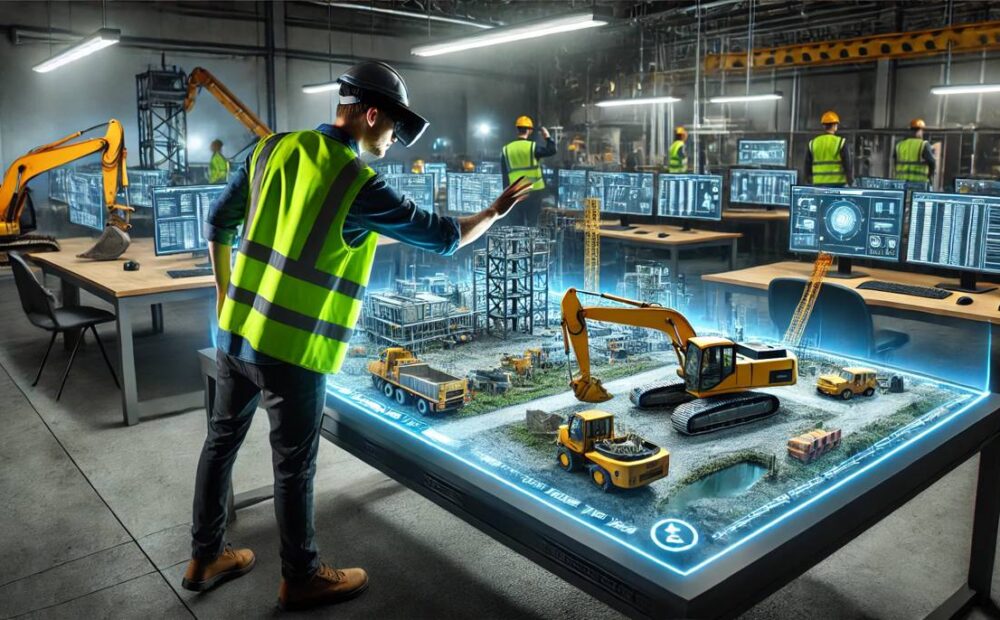
BIM creates a living, data-rich 3D model of a structure that architects, engineers, and contractors can all work from simultaneously, catching clashes and design flaws long before the first shovel hits the ground. Increasingly, that model doesn’t stop at design.
Digital twins now track a building throughout construction and into its operational life, feeding real-time sensor data back into the model so facilities teams can monitor performance, predict maintenance needs, and plan renovations with far greater precision.
This shift matters because commercial construction has historically run on thin margins and costly rework.
Industry estimates have long pointed to rework and miscommunication as some of the largest sources of waste on a job site.
A digital model that every stakeholder can see and update closes the communication gap that used to exist between the design table and the field.
Autonomous and Semi-Autonomous Equipment
Modern construction equipment increasingly includes features such as GPS-guided grading, automated machine controls, robotic layout systems, and remotely operated equipment.
These technologies improve precision while allowing operators to complete certain tasks more efficiently than traditional methods.
Autonomous capabilities are also expanding. While fully autonomous jobsites remain uncommon today, manufacturers continue to develop equipment capable of performing repetitive or hazardous tasks with decreasing levels of human supervision.
This matters more than it might first appear. With roughly 8% of new construction equipment already carrying some form of autonomy, and that figure expected to double within the next decade.
The industry is edging toward a future where the scarcest resource on a job site isn’t concrete or steel, but skilled operators.
Autonomy doesn’t replace those workers so much as multiply their reach, letting one experienced operator oversee equipment across a site or even across multiple sites.
Drones, Reality Capture, and Aerial Data
A quick flight over a site can generate a survey-grade topographic map, monitor progress against schedule, and flag safety issues, all without putting a person in a hazardous position.
Paired with photogrammetry and LiDAR, drones feed directly into BIM models, giving project managers an up-to-date, bird’s-eye comparison of what’s built against what was planned.
This kind of reality capture is also reshaping accountability on a project.
Instead of relying on periodic site visits and static progress photos, owners and general contractors can review time-stamped aerial data whenever they need it.
This shortens disputes over delays and makes it far easier to verify subcontractor progress for payment applications.
Artificial Intelligence and Predictive Analytics
Machine learning models trained on historical project data can flag scheduling risks before they cause delays, predict which subcontractors are likely to fall behind, and identify safety patterns that precede incidents.
On the estimating side, AI-assisted takeoff tools are cutting the time it takes to price a bid from days to hours, while still improving accuracy.
Generative AI also appears in early design and planning, helping architects and engineers rapidly explore layout options against constraints like cost, code compliance, and material availability.
Prefabrication and Off-Site Construction
Technology is also changing where construction takes place.
Instead of building every component on-site, many contractors now use prefabrication and modular construction.
Walls, structural elements, mechanical systems, and even fully finished rooms can be manufactured in controlled factory environments before being transported to the job site for installation.
The benefits extend well beyond convenience. Prefabrication reduces material waste, improves quality control, and shortens construction schedules by allowing site work and manufacturing to happen at the same time.
Because much of the work moves indoors, contractors are also less vulnerable to weather delays that can slow traditional construction.
For an industry facing an ongoing shortage of skilled labor, prefabrication offers another important advantage.
Smaller crews can assemble factory-built components much faster than constructing them entirely on-site, helping contractors deliver projects more efficiently without compromising quality.
Addressing the Skilled Labor Shortage
The U.S. construction workforce includes roughly 8 million people, yet many experienced tradespeople are approaching retirement while fewer younger workers are entering the skilled trades.
As demand for commercial construction continues to grow, contractors face increasing pressure to deliver more projects with a smaller labor pool.
Technology is helping the industry adapt to that reality.
AI streamlines planning and administrative tasks. Connected jobsites improve coordination and reduce delays.
Automated and semi-autonomous equipment allows operators to complete repetitive work more efficiently and with greater precision.
Together, these technologies enable project teams to accomplish more without simply adding more labor.
There’s also a recruitment angle worth noting.
A generation raised on smartphones and video games is, in some cases, more drawn to a construction career that includes robotics, or remote equipment operation, than one built entirely around traditional manual trades.
It’s an evolution that could help attract the next generation of talent while strengthening the industry’s long-term workforce
Wearable Technology Is Improving Jobsite Safety
Construction has always been a physically demanding profession, and even with strict safety protocols in place, job sites remain high-risk environments.
Wearable technology is giving contractors another layer of protection by helping identify potential hazards before they become serious incidents.
Today’s wearable devices go far beyond hard hats and reflective vests.
Smart helmets, connected safety vests, and wearable sensors can monitor a worker’s location, detect falls, track fatigue, and measure exposure to extreme temperatures or hazardous gases.
If a worker enters a restricted area or experiences a medical emergency, these devices can immediately alert supervisors, allowing them to respond more quickly.
Wearables also help contractors take a more proactive approach to safety.
Instead of investigating accidents after they occur, project teams can use real-time data to identify patterns, evaluate workplace risks, and implement corrective measures before incidents happen.
This not only helps reduce injuries but also minimizes costly disruptions that can affect project schedules.
Smarter Equipment Is Making Operators More Efficient
Technology isn’t only changing how projects are planned—it’s also changing how heavy equipment is operated.
Many modern construction machines now feature digital displays that provide operators with important information without taking their attention away from the job.
Instead of constantly looking down at gauges or separate monitors, operators can view guidance, machine data, and safety alerts within their normal field of vision.
These smarter display systems help reduce distractions while improving precision, especially during tasks that require careful grading, excavation, or material handling. They also make it easier to train new operators by providing clear, real-time guidance as they work.
The Road Ahead
Commercial construction is still, at its core, a business of moving atoms: pouring concrete, raising steel, and closing in buildings against the weather.
What is changing is how those projects are planned, managed, and delivered.
And as labor shortages persist, project schedules tighten, and client expectations continue to rise, contractors are under increasing pressure to deliver more with fewer resources.
Technology it’s giving them the tools to work smarter, solve problems faster, and deliver better outcomes.
The future of commercial construction won’t be defined by technology alone. It will be shaped by how effectively companies combine innovation with the experience, craftsmanship, and project management expertise that have always been the foundation of successful construction.
Those that embrace both will be best positioned to deliver safer, more efficient, and more successful projects in the years ahead.
Leave a Reply